URL rewrites + clean 301s
Full audit of product/category url_keys, detection of 301 chains (3+ redirects), cleanup of 404 sinkholes. Magento url_rewrite table = source of truth, we verify it line by line on large catalogs.
Magento (Adobe Commerce) gives total control: editable URL rewrites, native multilingual store views, catalogs of 100,000 SKUs without sweat. In exchange, it demands rare technical rigor. A poorly executed Magento audit stacks 301 chains, indexed facets, and Varnish misses. Here's our method.
Why Magento is different
No imposed limits: you edit URL rewrites, configure each facet, choose your Elasticsearch. But every mis-config pays in red Core Web Vitals and thousands of duplicate pages. The Magento challenge isn't working around the CMS — it's taming its technical surface.
Our 6 Magento levers
Magento requires code + config + infra interventions. Our levers are ranked by measured SEO impact: URL cleanliness > performance > catalog > multilingual.
Full audit of product/category url_keys, detection of 301 chains (3+ redirects), cleanup of 404 sinkholes. Magento url_rewrite table = source of truth, we verify it line by line on large catalogs.
robots.txt + canonical config for layered navigation: primary facets (color, brand) indexed, secondary facets (price, size) noindex + canonical to parent category. Avoids millions of crawled facet URLs for nothing.
FR/EN/AR via native store views: each store view = base_url + locale + hreflang. Verification that each product has its translation, hreflang is consistent, no store view duplicates French.
Varnish Full Page Cache with clean invalidation (tags), Redis sessions + cache, Elasticsearch tuning for 10k+ SKU catalogs. Native Magento 2 image lazy load + WebP conversion via module. LCP target: < 2.5 s.
Magento generates Product schema automatically (price, availability, variants). We enrich: long description (300+ words), per-product FAQ (via module), structured reviews (AggregateRating), relevant related products (SEO linking).
Magento has 500+ SEO modules on Marketplace. 80 % are harmful (bloat, conflicts, invalid schema). We keep only the proven: Mageplaza SEO (auto meta), Amasty XML Sitemap, custom modules if needed.
Our Magento stack
Every Magento module adds PHP executed on each request. 50+ active modules = TTFB that explodes. Our typical stack stays minimal: SEO core + perf + reviews. Period.
Common Magento pitfalls
Magento has more traps than Shopify — huge technical surface — and each trap costs months of indexing. If you recognize a description on the right, act quickly.
Millions of facet URLs crawled: /jeans?color=blue&size=42&sort=price-asc&page=3. Google crawls 500k URLs for a 5k product catalog. Crawl budget blown, real pages indexed late.
robots.txt + canonical config: primary facets (color, brand) index + canonical to category, secondary facets (price, sort, pagination) noindex. Sitemap limited to canonical URLs only.
After migration or url_key change: /product-a → /product-b → /product-c (3+ redirects). Google gives up after 2 hops. Orphan pages, lost PageRank, silent 404s.
Full url_rewrite table audit: each chain reduced to 1 direct redirect. SQL cleanup script. Search Console monitoring → Pages → Not indexed → Soft 404 / redirect.
FR + EN + AR via store views but incomplete translations: 50 % of products still in French in EN store view. Google sees massive duplicate content, penalizes all 3 versions.
Systematic audit: each product + category must have its own translation in each store view. hreflang verified product by product. Untranslated products = temporary noindex until translation.
Magento out-of-the-box on large catalog: mobile LCP 5-8 s, TTFB 2-3 s, 100+ HTTP requests per page. Mobile users abandon, Core Web Vitals red, SEO plateaus.
Perf stack: Varnish FPC + invalidation tags, Redis sessions/cache, tuned Elasticsearch, PHP 8.2 + OPcache, native WebP images, JS/CSS merge+minify. Target: LCP < 2.5 s, TTFB < 600 ms.
150+ active modules: most inherited from theme or previous dev. Each module = executed PHP, DB queries, overhead. TTFB goes from 400 ms to 2 s.
Module-by-module audit via bin/magento module:status: what's used? Disable dead modules. Keep < 50 active modules on standard Magento 2. Query log + Blackfire monitoring.
How we audit
Magento audit is the longest among our CMS audits: huge technical surface (code + config + infra + catalog). Each phase has its intermediate deliverable so you see progress.
Screaming Frog crawl (500k URLs if needed), url_rewrite table inspection, Varnish/Redis/ES config, PHP-FPM, active modules. Blackfire / New Relic profiling. Mobile + desktop Lighthouse.
Audit per category (meta, canonical, layered nav config, robots filter), per product (url_key, meta, schema, reviews, related products). Sampling on > 10k SKU catalogs.
If multilingual: each store view inspected (base_url, locale, translations, hreflang per URL). Inter-store duplicate content detection. Multilingual competitor benchmark.
60-100 page document with detailed findings + 6-12 month roadmap ranked by effort/impact. 90-min debrief with your tech + marketing + ops teams.
Measured results
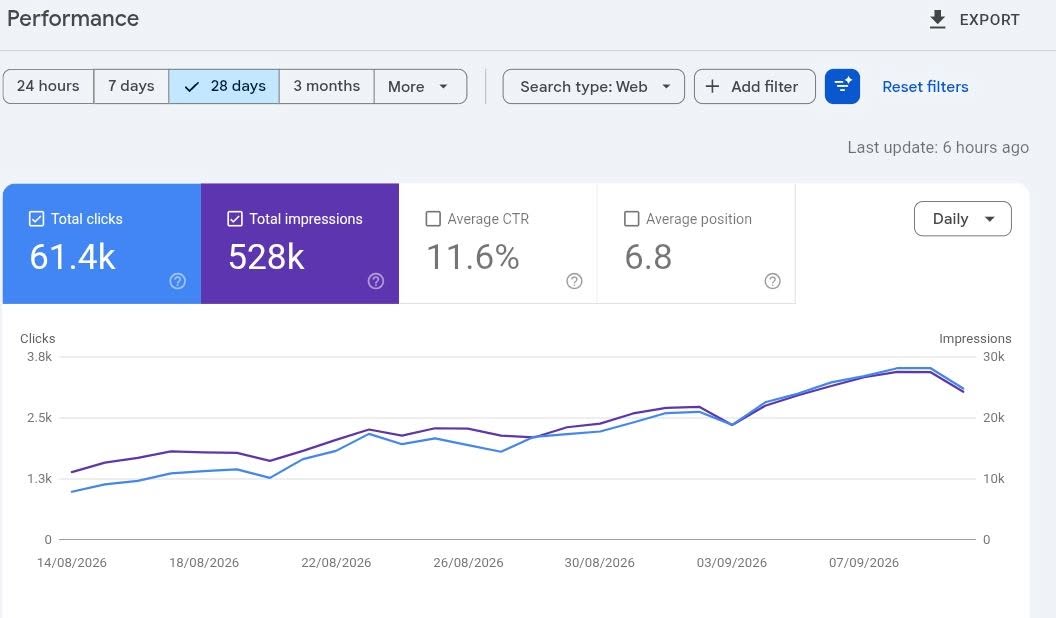
Yassinext.com doesn't run on Magento — but we apply the same SEO methodology to every CMS we audit. Visibility gains on our own site come straight from Google.
Source: Google Search Console — yassinext.com, last 28 days.
Magento audit pricing
Price depends on catalog size (10k vs 100k SKUs changes everything), number of store views, and scope (SEO audit alone vs SEO + perf + infra audit). A free audit in 5 days always precedes the paid proposal.
See SEO pricing in MoroccoFAQ
Six answers to frame your project before the first exchange.
Ready to tame Magento?
You submit your Magento URL + admin access if possible, we return 10 technical, catalog and infra priorities ranked by impact — with clear identification of modules to disable and rewrites to clean. Zero commitment.
magento.