SEO-optimized collections
Each collection = transactional SEO page with its H1, editorial intro (300-800 words), CollectionPage schema. Shopify allows a rich-text block at the top of collections: we use it systematically.
Shopify delivers the market's best default Core Web Vitals. But its /products/* canonicals, forced product URLs, and unchangeable pagination create specific SEO traps. Here's our method to leverage its strengths and work around its blockers.
Why Shopify is different
No PHP dev, no server, no plugins that break. In exchange: you can't modify pagination canonicals, product URLs are forced to /products/*, and the editorial blog stays rigid. Our expertise consists of maximizing what Shopify does well, and cleanly working around what it doesn't allow.
Our 6 Shopify levers
No code to write for most. The Shopify challenge is choosing the right apps, structuring collections correctly, and leveraging Shopify Markets if multilingual.
Each collection = transactional SEO page with its H1, editorial intro (300-800 words), CollectionPage schema. Shopify allows a rich-text block at the top of collections: we use it systematically.
Shopify ships clean Product schema by default (price, availability, variants). We add: long description (300+ words), per-product FAQ, review markup via app, multiple optimized images, SEO metafields.
For FR/EN/AR: Shopify Markets handles hreflang automatically, per-market currency, language detection. Clean config essential: we verify each market has its language + currency + domain (yoursite.ma / yoursite.com).
Catalog export to Google Merchant Center via official Google & YouTube app. Enriched product attributes (GTIN, condition, availability), clean Google categorization, promotions. Shopping feed and organic SEO share 80 % of signals.
Shopify has 10,000+ apps. 80 % are harmful to SEO (bloat, slow). We keep only proven apps: Google & YouTube (feed), Judge.me (reviews), Shogun (if SEO page builder needed), Searchanise (if internal search). No miracle "SEO suite" app.
Light editorial (< 1 article / week): native Shopify blog is enough. Heavy editorial: we recommend WordPress on blog.yoursite.com or headless CMS, with combined sitemap so Google sees a single coherent site.
Our Shopify stack
Every Shopify app adds JavaScript to the store. Too many apps = Core Web Vitals that drop. Our typical stack is minimal: organic SEO + shopping feed + reviews. Period.
Common Shopify pitfalls
Shopify has fewer traps than WordPress — the ecosystem is cleaner — but these five come up systematically. If you recognize a description on the right, act.
Empty collection pages: just a product grid, no editorial H1, no description. Result: they don't rank on category queries ("black women shoes").
Add a rich-text block at the top of each collection: descriptive H1, 300-800 words of editorial intro, FAQ if relevant. Native Shopify, no app.
Promo apps, popups, upsell, loyalty, cross-sell, AI assistant — each adds 100-300 KB of JS. Mobile LCP goes from 2 s to 5+ s.
App-by-app audit: what measured revenue does it bring? If no proof, uninstall. Keep only: SEO (Google & YouTube), reviews, search (if large catalog).
Shopify Markets activated but inconsistent hreflang, mixed currencies across markets, language detection redirecting in loops. Google doesn't understand which version to index.
Clean Markets audit: one market = one language + one currency + one domain or subdomain. Hreflang verified per country via Search Console → Pages → International targeting.
Google app installed but feed in error on Merchant Center (missing GTINs, empty Google categorization, images too small). 50-80 % of catalog rejected.
Merchant Center audit → Diagnostic → fix each error. Add GTIN on every product (metafield), configure Google Product Category per collection, upload images > 800×800.
100+ articles on native Shopify blog. No custom categories, no internal linking, fixed templates. Articles don't rank despite volume.
If editorial > 2 articles/week: migrate to WordPress on blog.yoursite.com (combined sitemap with Shopify) or headless CMS. Shopify stays for catalog only.
How we audit
Shopify audit is faster than WordPress audit (less technical attack surface) but deeper on the catalog: each collection, each product page deserves evaluation.
Screaming Frog crawl, inspection of /products/* vs /collections/*/products/* URLs, canonicals, sitemap, robots.txt, Lighthouse perf. Detection of installed apps and their perf impact.
Collection audit (editorial content, schema, linking), product audit (description, images, Product schema, variants). Sampling on sites > 500 SKUs.
If multilingual: Shopify Markets config, hreflang, currencies. Google Merchant Center audit: feed health, errors, categorization, promotions. Shopping competitor benchmark.
40-80 page document with findings and 6-month roadmap ranked by effort/impact. 60-min debrief with your marketing + merchandising teams.
Measured results
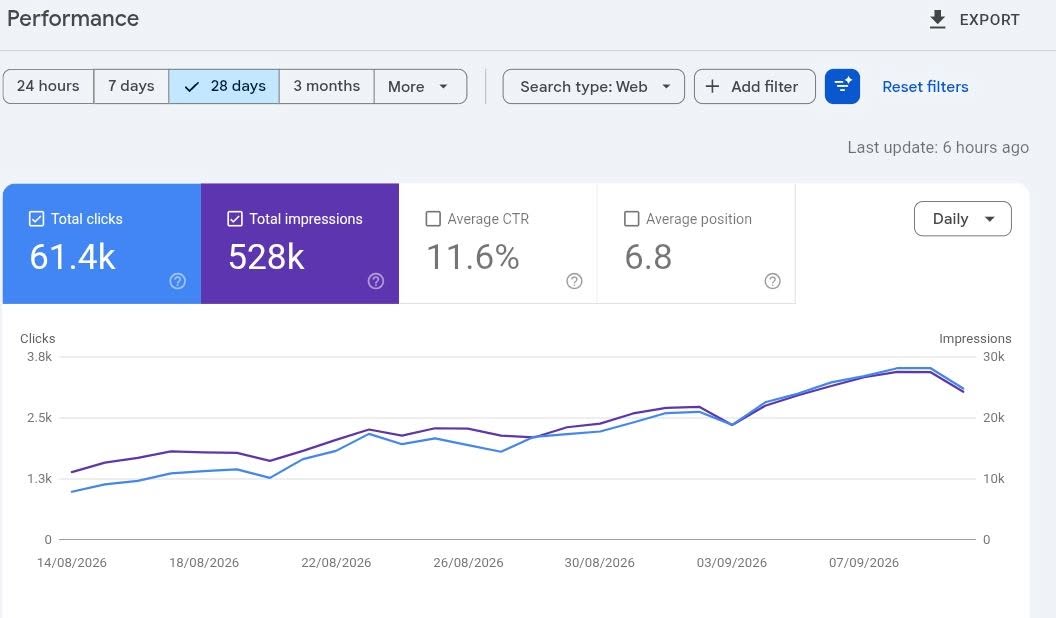
Yassinext.com doesn't run on Shopify — but we apply the same SEO methodology to every CMS we audit. Visibility gains on our own site come straight from Google.
Source: Google Search Console — yassinext.com, last 28 days.
Shopify audit pricing
Price depends on catalog size, multilingual, and scope (audit alone vs monthly engagement + Merchant feed). A free audit in 5 days always precedes the paid proposal.
See SEO pricing in MoroccoFAQ
Six answers to frame your project before the first exchange.
Ready to leverage Shopify's strengths?
You submit your Shopify URL, we return 10 technical and editorial priorities ranked by impact — with clear identification of apps to uninstall and collections to enrich. Zero commitment.
shopify.