Skip to content
Industry Expertise · B2B

B2B SEO. Low volumes. Strong intent. Measurable ROI.

In B2B you don't sell to a consumer — you sell to a buying committee comparing 3 to 7 vendors over 2 to 6 months. Each committee member has their own questions, at their own funnel moment. B2B SEO wins when it answers each at their stage: TOFU (discovery), MOFU (evaluation), BOFU (decision).

See the SEO funnel
20+B2B sites audited
6B2B SEO levers
3funnel stages
3languages (FR·EN·AR)

Why B2B is different

B2B has the best SEO ROI — if you accept the cycle's patience.

A qualified B2B lead is worth 10 to 1000 times an e-commerce click. B2B SEO ROI is the highest in digital — but the cycle is long (3-12 months between first click and signature). Winners install an authority content machine instead of chasing low-volume head queries.

Low volumes, high valueA B2B keyword like "SEO agency Morocco" has 400 searches/month. E-commerce "Nike shoes" has 50,000. But 1 signed B2B lead = 10,000-100,000 MAD value vs 300 MAD for shoe basket. ROI is inverted: less volume, more value per unit.
Multi-persona buying committeeA B2B purchase involves 3-7 people: technical prescriber (identifies need), economic decision-maker (validates budget), influencers (challenge the proposal). Each persona has their own SEO questions. A single piece of content doesn't reach everyone.
Editorial authority = criterion #1In B2B, Google favors sites showing real sector expertise (E-E-A-T). Articles signed by an expert, real case studies, white papers, webinars, public speaking. Authority builds over 12-24 months — but once installed, it's very hard to dislodge.
Precise and measurable ROIA qualified B2B form passes through CRM (HubSpot, Pipedrive, Salesforce). You can trace: SEO → page → form → MQL → SQL → opportunity → signature. SEO attribution is the best in digital for B2B — provided GTM/GA4/CRM tracking is aligned from kickoff.

Our 6 B2B levers

Six interventions that transform a B2B site.

B2B levers combine authority content (hub-and-spoke), technical SEO (Service schema, FAQ, HowTo) and lead gen (forms, LinkedIn, email). All three axes must reinforce each other.

01

Authority content hub-and-spoke

A hub = pillar page (3000-5000 words) covering a broad topic (e.g. "technical SEO"). Spokes = 10-30 related articles (schema, hreflang, Core Web Vitals, etc.) pointing to the hub. Each page = one long query treated in depth.

02

Structured B2B service pages

Each service = dedicated page with Service schema: description, measurable benefits, use cases, FAQ, pricing (if possible), contact CTA. 1500-3000 words. Avoids vague service pages ranking on nothing.

03

Client case studies (cornerstone)

Each delivered project = case study with client, context, numbers (if consented), methodology, result. Format: 1000-2000 words. B2B proof #1 for Google (E-E-A-T) and prospects. Target: 10-30 case studies on site within 24 months.

04

Lead magnets + nurturing

White papers, templates, checklists, free calculators in exchange for email. Feeds email base for nurturing. SEO sends qualified traffic, lead magnet converts to MQL, email nurturing converts to SQL.

05

Service + FAQPage + HowTo schema

Service schema per offering (with provider, serviceType, areaServed, offers), FAQPage on all service pages and guides, HowTo on tutorials. B2B rich snippets = +30 to +50 % CTR on competitive informational queries.

06

End-to-end CRM-integrated tracking

GTM + GA4 with custom events per funnel stage. CRM integration (HubSpot, Pipedrive, Salesforce) with captured UTMs. Monthly reporting: SEO traffic → sessions → forms → MQL → SQL → opportunity. Without this, B2B ROI stays invisible.
The B2B SEO funnel

Three funnel stages, three contents different.

Most B2B sites only produce BOFU content (service pages, pricing, demo request). Result: they only capture prospects 2 weeks from contact. To touch the full cycle (3-12 months), build content for all three stages.

01TOFU — Discovery

TOFU content (top funnel)

Capture prospects at the moment they identify a problem — they're not yet looking for a solution, they're seeking to understand.

Format: educational blog articles 1500-3000 words, infographics, podcasts, short videos. Examples: "what is technical SEO", "how to calculate marketing ROI", "the 5 SMB cybersecurity challenges". Soft CTA: newsletter, free white paper.

02MOFU — Evaluation

MOFU content (mid funnel)

Capture prospects evaluating solutions. They know the problem, they compare approaches and vendors.

Format: comparisons, how-to guides, case studies, calculators. Examples: "in-house SEO vs agency", "CRM tools comparison for SMBs", "calculated ROI technical SEO audit". CTA: demo, free consultation, audit.

03BOFU — Decision

BOFU content (bottom funnel)

Capture prospects ready to sign. They've short-listed 2-3 vendors and seek to validate their choice.

Format: detailed service pages, pricing (if possible), "why choose us" pages, sector case studies, commercial FAQ. Examples: "SEO agency Casablanca", "B2B SEO audit pricing", "our SaaS client results". CTA: direct contact, quote, demo.

Common B2B pitfalls

Five mistakes we find in 80 % of B2B sites.

B2B is the sector where sites focus too much on BOFU and neglect TOFU/MOFU. Result: low traffic, SEA/outbound dependency, invisible SEO. These 5 pitfalls come up systematically.

01

100 % BOFU site, zero editorial authority

What we see

Site has: home + service pages + pricing + contact. That's it. No blog, no white papers, no case studies. Organic SEO = 0 traffic. Site lives only on SEA and outbound.

What to do

Build a hub-and-spoke: 3-5 pillar hubs (broad topics) + 30-80 spoke articles. Case studies (10-30). Downloadable lead magnets (5-15). In 18 months, SEO becomes lead gen channel #1.

02

Vague service pages ranking on nothing

What we see

"Our services" page listing 10 offerings in 100 words each. No Service schema, no FAQ, no linked case study. Result: doesn't rank on "agency X city" despite 10 years of activity.

What to do

Each service = dedicated page 1500-3000 words with full Service schema, FAQ (5-10 questions), linked case study, pricing or range, contextual CTA. Linked to relevant hub.

03

Non-existent or generic case studies

What we see

"We helped a client increase traffic 300 %." No name (confidentiality), no numbers (not relevant), no methodology (secret). Zero value for SEO + prospect, Google doesn't read as proof.

What to do

Real case studies with named client (if consented), precise context, measurable numbers (or range), detailed methodology. If no consent: anonymized case study but with real numbers, sector and company size identified.

04

Forms without CRM tracking

What we see

WordPress Contact Form 7 sending email. No UTM, no CRM integration, no MQL/SQL scoring. Impossible to say which SEO page generated which lead that converted to signature.

What to do

GTM + GA4 with custom events (page_view, form_submit, download, demo_request). Minimum CRM integration: HubSpot Free or Pipedrive. UTMs captured in CRM. Monthly dashboard: SEO → MQL → SQL → opportunity → signature.

05

Zero authority signals (E-E-A-T)

What we see

Unsigned articles, no author bio, no LinkedIn, no public speaking, no Google reviews on organization. Google has no real expertise signal. Algorithm demotes.

What to do

Each article = named author with bio + LinkedIn + Person schema. "Team" page with detailed expertise. External speaking (podcast guests, guest articles, conferences). Google reviews with aggregateRating on Organization.

How we audit

Four phases. 6 to 10 weeks depending on size.

A B2B SEO audit covers site + CRM + tracking + editorial authority. We look at the full SEO → CRM → signature funnel, not just rankings.

  1. 01

    Technical + content audit

    Site crawl, pages inventory per stage (TOFU/MOFU/BOFU), schema audit (Service, FAQ, HowTo, Person), multilingual audit, CWV performance. 5-10 direct + indirect competitors benchmark.

  2. 02

    Authority + E-E-A-T audit

    Authors audit (bios, Person schema), case studies (volume, quality, numbers), external signals (LinkedIn, podcasts, guest articles), Google Organization reviews. Gap analysis vs sector leaders.

  3. 03

    Tracking + CRM + funnel audit

    GTM/GA4 inventory, CRM integration, UTMs, MQL/SQL scoring. SEO traffic → forms → MQL → SQL → opportunity mapping. Identification of converting pages and funnel leaks.

  4. 04

    Deliverable + 18-month roadmap

    50-100 page document with audit + 18-month roadmap (phase 1 tracking foundations + quick wins, phase 2 pillar hubs + case studies, phase 3 authority + conversion). Priorities quantified by expected MQL impact.

Measured results

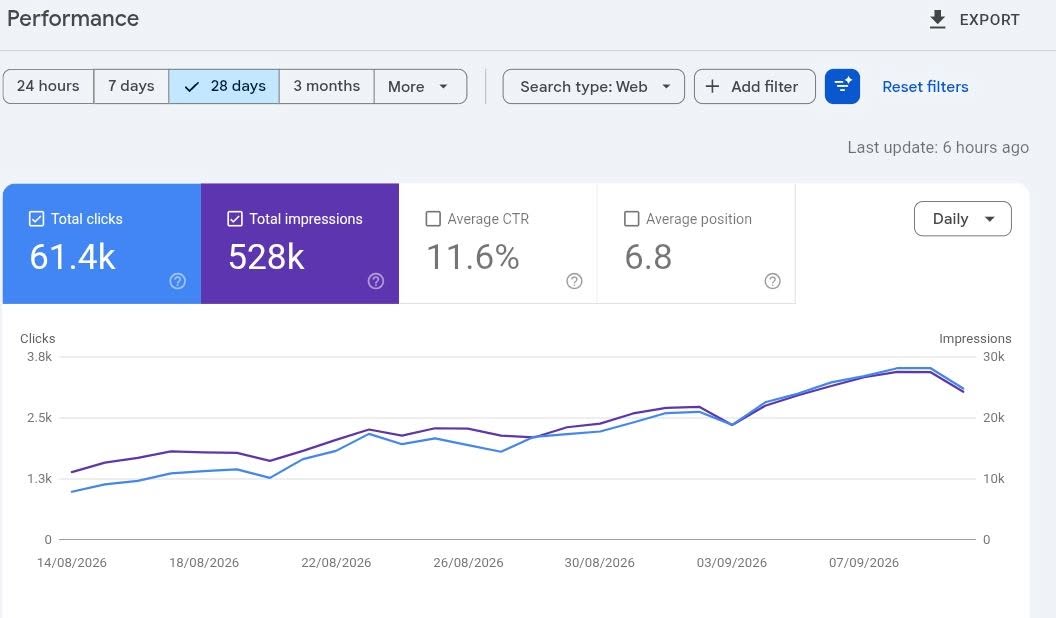
Yassinext's own Search Console. Numbers straight from Google.

Yassinext.com is itself a B2B site selling B2B SEO — our numbers are proof the method works on our own funnel.

Clicks · 28 days
61.4k
Impressions
528k
Average CTR
11.6%
Average position
6.8

Source: Google Search Console — yassinext.com, last 28 days.

Search Console — yassinext.com

B2B audit pricing

How much does a B2B SEO audit cost?

Price depends on site size, multilingual, and scope (audit alone vs audit + content production + CRM support). A free audit in 5 days always precedes the paid proposal.

See SEO pricing in Morocco
B2B Starter10,000 MAD · SMB < 50 pages, single market · 4 weeks
B2B Standard20,000 MAD · scaleup/firm 50-200 pages, 2-3 languages · 6 weeks
Monthly engagement10,000 to 30,000 MAD/mo · SEO + content + CRM + reporting

FAQ

What B2B decision-makers ask.

Six answers to frame your project before the first exchange.

How long for B2B SEO results?
Technical quick wins (schema, service pages, meta): 2-4 months for rankings. Pillar hubs + authority content: 6-12 months to install the machine. Measurable lead gen (SEO → MQL → SQL): 9-18 months depending on sector and competition. B2B is patient — but 18-month ROI is best in digital. Most B2B clients see SEO become lead gen channel #1 after 18-24 months.
Can we do B2B SEO without CRM?
Technically yes, but ROI becomes invisible. Without CRM, you see SEO traffic and form submissions, but you can't trace MQL → SQL → signature. After 6 months, impossible to say if SEO brings money or not. Vital minimum: HubSpot Free + GTM/GA4. Ideal: HubSpot or Pipedrive with captured UTMs and scoring.
Do we need a blog for a B2B site?
Yes, imperatively. Blog = B2B SEO pillar. Without blog, no TOFU content, no editorial authority, no broad indexing. Recommended pace: 2-4 articles/month to start (first 6 months), 1-2 articles/week after. Each article = 1500-3000 words, signed author, hub-and-spoke linking. 90 % of B2B clients publish via native WordPress blog.
Do you produce B2B content?
Yes, we have B2B specialized writers (SaaS, pro services, industry). Writing included in monthly packs. For very technical topics (e.g. SEO itself, quantitative finance, specialized engineering), we work in pairs: your expert writes V1, we SEO-optimize V2. 60 % of B2B clients use this hybrid model.
Do you work with HubSpot, Pipedrive, Salesforce?
We have proven integrations with HubSpot (most common in Morocco), Pipedrive (SMBs), Zoho (tight budget), and Salesforce (large enterprises). We configure GTM + GA4 + UTM + CRM so every submitted form traces to signature. We don't manage daily commercial relationship — that's your sales team — but we ensure reporting works.
Translate the whole B2B site to English?
Depends on your target. If you target: (a) French-speaking Morocco SMBs only = FR enough. (b) Morocco + Francophone Africa large enterprises = FR + EN for multinational accounts. (c) International SaaS = EN primary + FR secondary. (d) Gulf market = AR + EN. Each language = human writing (not Google Translate), verified hreflang, localized case studies. SEO ROI of EN version on enterprise segment is very high.

Ready to make SEO your lead gen channel #1?

Free B2B SEO audit. 10 priorities specific to your site, in 5 days.

You give us your URL, your CRM, your traffic volume. We return 10 technical, content and tracking priorities ranked by expected MQL impact. Zero commitment.

Talk to a consultant

btob.