- How it sources
- Mainly selects from the top-10 Google organic for the query, filtered by trust signals (schema, authority, freshness).
- Citation rule
- Favors concise passages between H2 and H3, bulleted lists, and definition paragraphs.
GEO. Generative Engine Optimization. Get cited when Google stops showing you.
AI Overviews, ChatGPT, Perplexity, Copilot. Answer engines already capture 25 to 40 % of informational searches — without ever showing the 10 blue links. GEO makes your content citable by these engines. It's the extension of SEO, not its replacement.
Why GEO is different
GEO isn't SEO with quotes around it.
Content ranking #1 on Google may never be cited by ChatGPT. The opposite is also true. Answer engines select, summarize, and attribute — they don't list. Selection criteria differ: structure, concision, entity authority, exhaustive schema, and above all the ability to answer in a self-contained passage.
The 4 target engines
Each engine has its citation rules.
There isn't "one" generative search. There are at least 4 that matter, each with a different sourcing mechanism. Serious GEO targets them explicitly.
- How it sources
- Combines its own web index (Bing + OpenAI crawl) with sources the user explicitly requests. Favors reference sites and official sources.
- Citation rule
- Cites 3 to 7 sources per answer, displayed at the bottom. Structured passages and FAQ are particularly well picked up.
- How it sources
- Shows citations at the top of the answer with highly visible design. Continuous web index. Favors recent, strongly structured sources.
- Citation rule
- Prefers dated passages, with sources themselves cited. Content with references/further-reading is valued.
- How it sources
- Uses the Bing index + GPT-4. Large business/enterprise audience. Professional queries tend to be numerous.
- Citation rule
- Cites 3 to 5 sources at the bottom. Favors corporate/institutional sources and content with Author schema.
Our 6 GEO levers
Six workstreams that make content citable.
No magic recipe. Six concrete interventions, applicable on an existing site, that increase the probability of being cited by answer engines.
Self-contained passages
Rewriting H2/H3 with a direct answer in the first 2 sentences. A reader (or an LLM) must understand without reading the rest. End of 300-word diluted intros.
Exhaustive schema
FAQPage, HowTo, Article, Author, Organization, Product with AggregateRating, Service. LLMs read structured data to understand relationships between entities.
Entity density
Audit of mentioned vs expected entities for the query. Natural addition of missing entities (Wikipedia-level: people, places, key concepts) without forcing.
Authority signals
Author schema with credible biographies, sameAs to LinkedIn/Wikipedia, press mentions, academic publications if relevant. LLMs favor identifiable sources.
llms.txt + bot management
llms.txt file (emerging standard) to frame what LLMs can use. robots.txt check for GPTBot, PerplexityBot, ClaudeBot, Google-Extended. Decide explicitly who has access.
Mention tracking
Monthly tracking: how many times your brand / pages are cited by ChatGPT, Perplexity, Copilot. Dedicated tools (Profound, Peec, manual queries). GEO without measurement is blind.
Citable passage anatomy
Same topic, two writings. Only one will be cited by ChatGPT.
Take a real query. Here's how a good SEO writer answers in 2024, and how a GEO writer answers in 2026. Both are correct. Only one is picked up in an AI answer.
In the universe of organic search in Morocco, the question of SEO audit pricing comes up frequently. It must be understood that many factors come into play to determine the cost of such a service. Indeed, site size, audit complexity, provider profile, and scope covered are all elements to consider before putting forward a figure…
- Diluted intro (3 sentences before the answer)
- Zero figures, zero entities, zero structure
- An LLM can extract nothing citable from this
An SEO audit in Morocco costs between 5,000 and 15,000 MAD depending on scope. The three standard formats are: Starter (up to 500 URLs, 5,000 MAD, 3 weeks), Standard (up to 5,000 URLs, 10,000 MAD, 4 weeks), and Enterprise (5,000+ URLs, from 15,000 MAD, 5 to 6 weeks). A free audit in 5 business days usually precedes the paid proposal.
- Direct answer in the first sentence
- Concrete figures, clear structure, entities (Starter, Standard, Enterprise)
- LLM can extract a self-contained 60-word passage
How we optimize
Four phases. From diagnosis to monthly tracking.
GEO isn't done by "publishing content." It's done by auditing, rewriting key passages, instrumenting tracking, then iterating monthly.
- 01
Citability audit
For each target query: how many engines already cite you, who they cite in your place, why. Competitive benchmark. Output: priority passage list to rework.
- 02
Passage rewriting
The 20 to 50 most strategic passages (major H2/H3 of pillar pages) are rewritten on the citable model: direct answer in 2 sentences, figures, structure, entities.
- 03
Schema + llms.txt + bot config
Deployment of missing schema (FAQPage, HowTo, Author), llms.txt publication, clean AI bot configuration in robots.txt.
- 04
Monthly tracking
Measurement of citations per engine, per query, per page. Drop alerts. Iteration on passages not picked up despite optimization.
Measured results
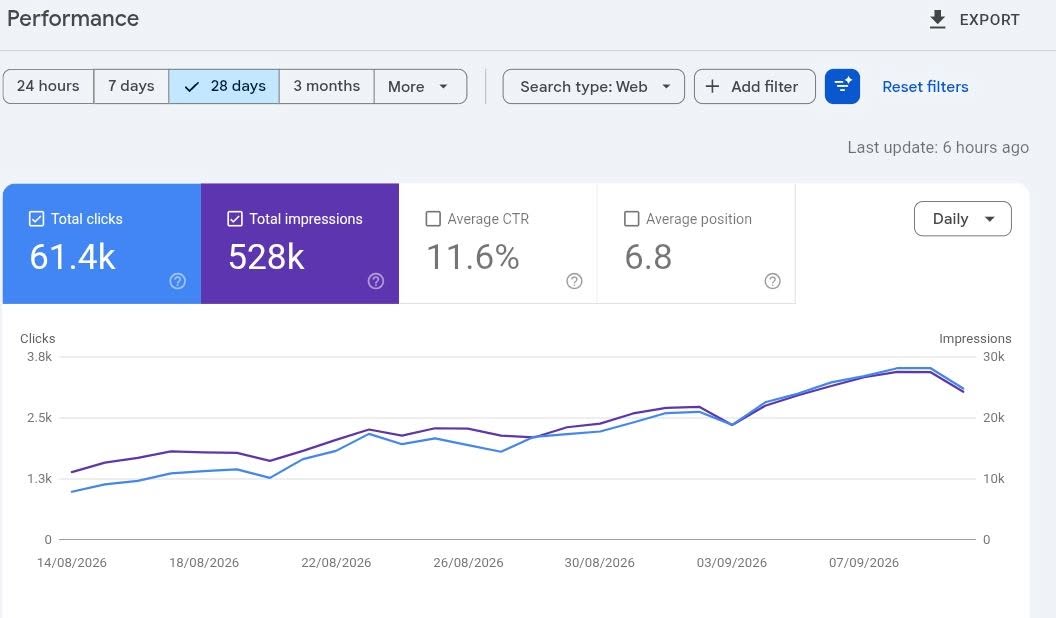
Yassinext's own Search Console. Numbers straight from Google.
We apply to our own site the GEO method we sell. Organic visibility gains come straight from Google. LLM citation gains are tracked separately and shared jointly with each client.
- Clicks · 28 days
- 61.4k
- Impressions
- 528k
- Average CTR
- 11.6%
- Average position
- 6.8
Source: Google Search Console — yassinext.com, last 28 days.

GEO pricing
How much does a GEO engagement cost?
GEO rarely sells on its own — it's added to an existing SEO engagement or a full audit. Standalone, we offer a one-shot audit and monthly tracking. A free audit always precedes the proposal.
See SEO pricing in MoroccoFAQ
What decision-makers ask before ordering GEO.
Six answers to frame your request before the first exchange.
- No — it extends it. Classic SEO continues to capture short transactional queries (where the 10 blue links remain dominant). GEO captures long informational queries (where AI Overviews and ChatGPT already take 25 to 40 % of searches). A site that only optimizes classic SEO mechanically loses visibility year after year on informational topics.
- Three complementary methods. 1) Repeated manual queries on 20-50 target queries each month, logging cited sources. 2) Emerging dedicated tools (Profound, Peec AI, Otterly) that automate monitoring. 3) Analysis of inbound referral traffic when ChatGPT/Perplexity still send clicks. Imperfect but measurable.
- No — it's the worst decision for your GEO visibility. Blocking AI bots guarantees you'll never be cited. Sites that block are immediately dropped from the LLM index. We recommend the opposite: explicitly allow citing bots (GPTBot, PerplexityBot, ClaudeBot), configure llms.txt to frame usage, and track citations.
- ChatGPT and Perplexity index very fast (days to 2 weeks after publication). Google AI Overviews is slower (4 to 12 weeks). First citations typically appear 1 to 3 months after complete setup (audit + rewrites + schema + llms.txt).
- Pillar pages addressing informational queries ("how to do X", "what is Y", "how much does Z cost"), FAQ, sector guides, and pricing pages. Transactional product pages and category pages benefit less — their classic SEO remains priority.
- Partially. Editorial content (guides, comparisons, advisory articles) extract the most value from GEO. Transactional PDPs and category pages mainly benefit from flawless Product/Offer schema for shopping queries in ChatGPT. We recommend a 70 % classic SEO + 30 % GEO mix on a typical e-commerce.
Does GEO replace classic SEO?
How do you measure ChatGPT citations?
Should I block GPTBot and PerplexityBot?
How long before seeing citations?
What content benefits most from GEO?
Does GEO work for an e-commerce site?
Ready to be cited when Google stops showing you?
Free GEO audit. 20 priority passages of your site to make citable.
In 5 business days, we audit your current citability on the 4 engines (AI Overviews, ChatGPT, Perplexity, Copilot), identify the 20 priority passages to rewrite, and return an action plan ranked by estimated impact. Zero commitment.
geo.