Pillar pages
Captures the head keyword of a topic cluster
Serious SEO writers haven't counted density in ten years. They think search intent, entities, semantic coverage, and reader-to-conversion flow. Our briefs look like spec sheets — not keyword checklists.
Why SEO writing is different
Google doesn't read keywords in 2026 — it reads entities, their relationships, and the quality of a topic's treatment versus what it expects for a query. Content that ranks precisely answers search intent, cites relevant entities, covers implicit sub-questions, and fits into coherent internal linking.
Six content types
No "blog article template." Each format answers a distinct search intent, with its own structure, length, schema, and internal linking.
Captures the head keyword of a topic cluster
Cover an informational question in depth
Convert on transactional intent
Capture broad commercial queries
Convert on a precise commercial query
Capture PAA + feed AI Overviews
Brief anatomy
Before writing, each piece gets a detailed brief — it's 60 % of the final quality. A good writer with a bad brief delivers bad content. The opposite is also true.
| Target query | SEO consultant Morocco |
|---|---|
| Dominant intent | Commercial (vendor selection) |
| SERP top 10 (format) | 7 agency pages · 3 blog articles |
| Recommended length | 2,800 words (top-10 median) |
| Entities to mention | Google · Search Console · Core Web Vitals · GEO · AI Overviews · schema · Morocco · Casablanca |
| Proposed H2 | 6 H2 structured by sub-intent |
| FAQ (6 Q&A) | Written on SERP PAA |
| Secondary keywords | 12 variations to distribute naturally |
| Internal links | 4 outbound links to site pillar pages |
| Call-to-action | Free audit (soft) + Contact (hard) |
How we write
No stream-of-consciousness writing. Each piece follows the same process — that's what makes quality repeatable and timeline predictable.
Top-10 SERP analysis, PAA extraction, entity mapping, length benchmark, competitor gap identification. Output: raw research document (10–20 internal pages).
Research transformed into actionable editorial brief: intent, H2 structure, mandatory entities, target length, FAQ, internal links, CTA. Output: 2–4 page brief.
A human SEO writer writes the piece from the brief. No LLM autopilot. If LLM used, it's co-writing: human outline, LLM first draft, full human rewrite.
SEO review (entity density, linking, meta, schema), editorial review (voice, consistency, quality), client validation. Publication with corresponding schema deployment.
Production modes
AI well used accelerates production without degrading quality. Badly used, it produces generic content that never ranks. We say honestly which mode we use on each piece.
Human SEO writer A to Z. Manual research, hand-written brief, human writing, zero LLM assistance.
Human research + brief, LLM-assisted first draft, full human rewrite and review. Equivalent quality to pure human, half the time.
Short human brief, LLM generation, express human review (correction, humanization, linking). Correct quality, minimum delay.
Measured results
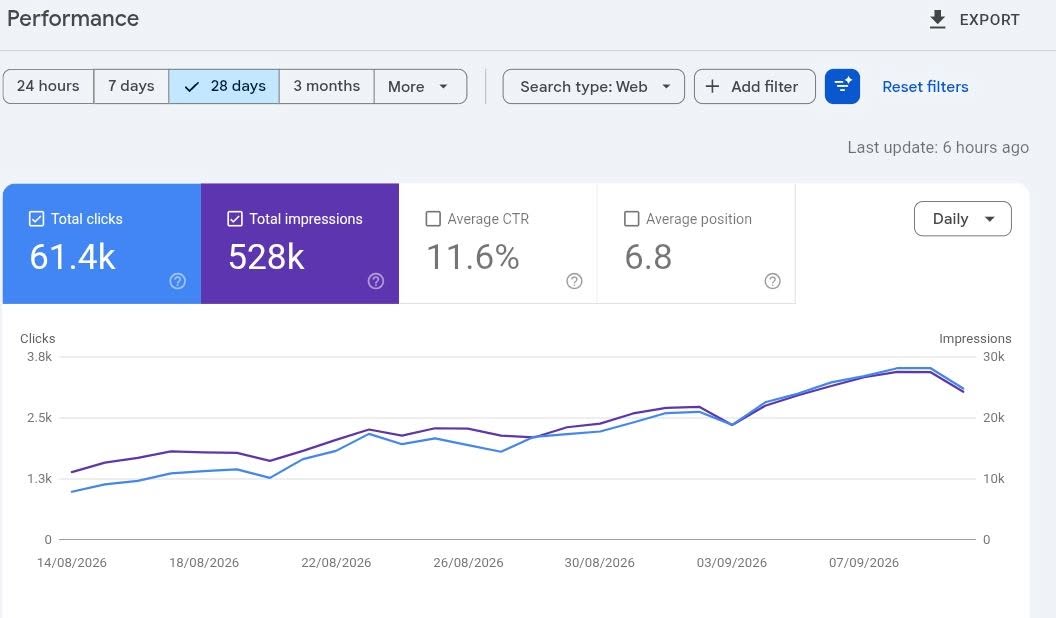
We apply to our own site the editorial methodology we sell. Visibility gains come straight from Google's tool. All content published on yassinext.com follows the same process.
Source: Google Search Console — yassinext.com, last 28 days.
SEO copywriting pricing
Price depends on production mode (human, co-writing, supervised LLM) and length. No flat per-content pricing — each piece is quoted after brief. A free editorial audit always precedes the proposal.
See SEO pricing in MoroccoFAQ
Six answers to frame your project before the first exchange.
Ready to publish content that ranks?
In 5 business days, we audit your existing content, identify competitor gaps, and return 10 priority pieces to produce over the next 6 months. With titles, intents, recommended lengths, and estimated impact. Zero commitment.
contenu.