Skip to content
Service · E-commerce SEO

E-commerce SEO. We don't sell positions. We sell orders.

Good e-commerce SEO isn't measured in impressions but in additional orders per month. We work on catalog architecture, Product schema, pagination, shopping feed, and Core Web Vitals — for Shopify, WooCommerce, PrestaShop, Magento, and custom-built stores.

See related work
6e-commerce levers
5platforms mastered
Revenuethe real metric
3languages (FR · EN · AR)

Why e-commerce is different

An e-commerce site isn't a corporate site with a cart.

A corporate site optimizes 20 pillar pages. An e-commerce has to manage 500 to 50,000 URLs — categories, sub-categories, filters, pagination, products, variants, promos. Each mechanic generates its own SEO opportunities — and its own index-bloat traps.

URL volume ×100An average e-commerce has 100× more pages than a corporate site. The right question isn't "which page to create" but "which pages to let get indexed".
Ultra-visual SERP resultsRich snippets (price, reviews, stock), product images, local pack, AI Overviews, Google Shopping. An e-commerce without Product schema leaves 15 to 30 % CTR on the table.
Core Web Vitals = RevenueEach 100 ms shaved off LCP earns ~1 % conversion on mobile. A slow e-commerce isn't a UX problem — it's a measurable P&L problem.
Shopping feed competitionAmazon, Jumia, Marjane, Walmart. An e-commerce's organic SEO has to coexist with Google Shopping, Pinterest, TikTok Shop — not be thought of in isolation.

Our 6 e-commerce levers

What makes an e-commerce sell from Google.

Six priority workstreams. We attack with the one that has the highest revenue impact for your context — not by default.

01

Catalog architecture

Categories, sub-categories, pillar pages, internal links. Every URL must have a reason to exist — and a reason to be canonical or noindex.

02

Product schema + rich results

Price, availability, reviews, variants, SKU, GTIN. Full deployment for rich-results eligibility and free Google Shopping listings.

03

SEO-safe faceted navigation

Color/size/price filters: index-safe by default, selectively indexable when there's search volume. Avoids the index-bloat hit that kills crawl budget.

04

Pagination & canonicals

Category pagination, product variants, seasonal promos, seller duplicates. Each pattern deserves its own canonical strategy.

05

Mobile Core Web Vitals

LCP, INP, CLS measured in field (CrUX) + lab (Lighthouse). Resource diagnosis, optimization plan quantified by page type (home / category / PDP).

06

Shopping feed & Merchant Center

Feed quality, Google Shopping categorization, promotions, free listings. Organic SEO and organic shopping share 80 % of their signals — we align them.

Platforms mastered

Shopify, WooCommerce, PrestaShop, Magento. Each CMS has its own SEO mechanics — and its own traps.

We audit and support five platforms covering 95 % of the Moroccan e-commerce market. The levers stay the same; the technical patterns change.

ShopifyHosted · easiest to rank, hardest to customize
Strengths
Fast, managed hosting, apps marketplace. Clean native Product schema.
Watch-outs
Non-editable pagination canonicals, forced product URLs, /products/* vs /collections/*/products/* duplicates.
WooCommerceWordPress · most flexible, most accident-prone
Strengths
Total control, mature WordPress SEO (Yoast / Rank Math), moderate costs.
Watch-outs
Index bloat on filters, duplicate variants, front-end performance dependent on theme and plugins.
PrestaShopOpen-source · dominant in Morocco
Strengths
Multi-store, native multilingual, clean hreflang, strong local community.
Watch-outs
Default URLs sub-optimal (id in slug tail), category pagination to watch, third-party modules that break canonical.
Magento / Adobe CommerceEnterprise · 10k+ SKU catalogs
Strengths
Advanced faceted search, customer segmentation, scalable performance.
Watch-outs
Heavy JS rendering, cross-store canonicals, high technical SEO implementation costs.
Headless / custom-builtNext.js, Nuxt, Astro + API
Strengths
Maximum performance, fine-grained SSR / ISR, unlimited flexibility on schema and architecture.
Watch-outs
Hydration and bot-invisible content, caching headers, sitemap-rendering consistency.

Measured results

Yassinext's own Search Console. Numbers straight from Google.

We apply to our own site the e-commerce method we sell (for e-commerce, the key figures are revenue and conversion rate — published jointly with each client, never without authorization).

Clicks · 28 days
61.4k
Impressions
528k
Average CTR
11.6%
Average position
6.8

Source: Google Search Console — yassinext.com, last 28 days.
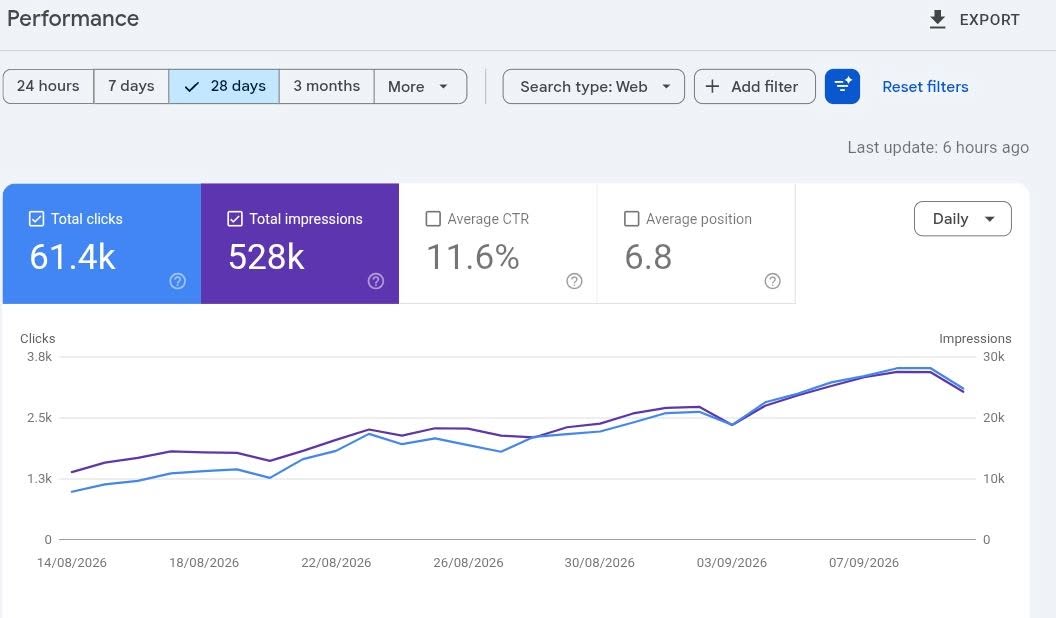
Search Console — yassinext.com

E-commerce SEO pricing

How much does an e-commerce SEO engagement cost?

Budget depends on catalog size (SKU count), platform, number of languages, and scope (organic SEO alone or coupled with shopping feed). A free audit always precedes the proposal.

See SEO pricing in Morocco
E-commerce audit one-shot5,000 to 15,000 MAD · 3 to 6 weeks
Monthly support5,000 to 15,000 MAD/mo · SEO + shopping feed
Full SEO rebuildCustom quote · architecture + migration + schema

FAQ

What e-commerce operators ask most.

Six answers to frame your project before the first exchange.

How long before SEO generates revenue?
On long-tail transactional queries (product + attribute, category + brand), additional orders often appear in 6 to 12 weeks. On competitive queries (e.g. "women shoes Morocco"), 4 to 9 months. A technically well-structured e-commerce sees results faster — which is why architecture precedes content.
Should I invest in SEO or Google Ads / Shopping?
Both — but not in any order. Organic SEO works informational and long-tail queries (low acquisition cost, long timeline). Google Shopping / Ads works short transactional queries (high cost, immediate). A good e-commerce does both and coordinates them at the Merchant Center feed level.
My catalog has 10,000 products — must all be indexed?
No — and that's often the trap. Many empty, duplicate, permanently out-of-stock, or variant-only product pages should be noindexed to preserve crawl budget and avoid dilution. We audit your catalog product by product (or by cluster) to frame indexation.
Should I create SEO category pages or let filters do the work?
Both. SEO category pages (e.g. /womens-black-shoes) capture head and torso queries. Filters (e.g. /womens-shoes?color=black) serve the user — but are usually noindexed, canonicalized to the parent category. Exceptions (highly-searched filter) are treated as full category pages.
Do you work with Shopify, PrestaShop, or Magento?
Yes, all three plus WooCommerce and custom (Next.js, Nuxt, Astro). SEO levers are the same everywhere; what changes are the technical touch-points (see the platforms section).
Is an e-commerce SEO audit different from a regular SEO audit?
Yes — deeper on technical (crawl, pagination, canonicals, faceted nav, feed), deeper on product (Product schema, variants, structured reviews). If you're e-commerce, ask upfront for an e-commerce audit (/services/audit-seo Standard or Enterprise pack).

Ready to turn positions into orders?

Free e-commerce SEO audit. 10 priorities ranked by revenue impact.

In 5 business days, we audit your e-commerce site, your Product schema, your Merchant Center feed, and your Core Web Vitals. You receive the 10 priorities ranked by estimated revenue impact.

Talk to a consultant

e-commerce.